The minimum wage is a controversial topic. One side says raising wages will harm businesses. The other side says an economy can’t function without a livable wage for all people. The issue is ultimately an economic issue. Good old fashion supply and demand. However, it is also a metaphysical issue, because it deals with the value of one hour of a human being’s life.
Let’s be clear. Wages are people selling their time, labor, skill, and/or knowledge for money. The workers are sellers and the businesses are buyers. Classic supply and demand curve means that the seller wants the wage as high as possible, and the buyer wants the wage as low as possible. This negotiation plays out in the job interview process where the company posts the wage and the applicant agrees to it. If the business discovers a pattern of applicants denying the proposed wage, then the business must decide either to raise the wage or go without the labor.
The minimum wage is a piece of legislation that was introduced in 1938 (back then it was $0.25 which is $5.58 in 2024 dollars). In Economics, government legislation is often correlated with market inefficiencies. In other words, government action forces buyers and sellers to act differently than they otherwise would in a free market economy. This could be a good thing or a bad thing. With all things, prudential judgement is important to know what’s the best path for the majority of people. In my spirituality of wealth, government intervention should be seen with greater benevolence than the typical capitalist enthusiast would grant it. For justice to flourish in society, we do need laws from the government to regulate activity to some degree. (Preferably as little as possible.)
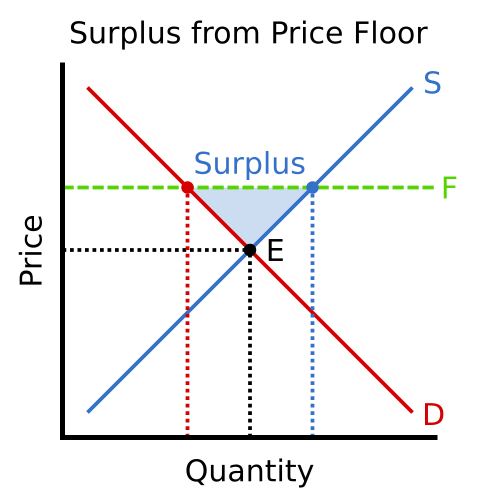
The minimum wage is what’s consider a price floor. (Personal note: It bugs me so much that the “floor” is on the top of the diagram) It is called a floor because the supply and demand rests on the floor and cannot go below the floor. The price floor implies that businesses are willing to offer more jobs, but it will be at a lower wage. The reverse would be true that as wages increase, then less jobs will be offered. That is the simple economics of the matter.
Can we as Catholics argue for no government intervention? We could but it will put us in an awkward place with the magisterium of the Catholic Church. The laissez faire capitalism is spoken against in a few encyclicals by the vicars of Christ (a.k.a. the pope) in the 20th century. For example in Centesimus Annus JP2 writes,
“Furthermore, society and the State must ensure wage levels adequate for the maintenance of the worker and his family, including a certain amount for savings. This requires a continuous effort to improve workers’ training and capability so that their work will be more skilled and productive, as well as careful controls and adequate legislative measures to block shameful forms of exploitation, especially to the disadvantage of the most vulnerable workers, of immigrants and of those on the margins of society. ” – Centesimus Annus
The Catholic Church prefers to operate “Via Negativa” which is Latin for defining something by what it is not. Therefore, the Catholic Church more readily says “something is wrong” to do as opposed to saying “something is right to do.” This leads to a common frustration with the Vatican because the Vatican usually abstains from saying directly “This is good to do and all people should do it.” As frustrating as it is, there is wisdom in respecting the prudential judgement of the people. After all, there are many paths to Sainthood and all people are called to be Saints. Why unnecessarily narrow an already narrow path?
In terms of the minimum wage, the Vatican will probably never say, “Pay people this much.” What they will say, and similar to what has been said in the encyclical above, is more like, “it is wrong that people labor in inhumane conditions and have no hope of flourishing with the job that they have chosen.” Not helpful when crafting legislation, but it conveys the message of the Gospel adequately enough.
Therefore, it is up to society and the individuals of that society to decide exactly what is worth one hour of a human person’s time. This is a market transaction. So, let’s look at it from both the supply and demand perspective. The supply perspective are the workers that are willing to sell their time/labor to the business. The demand perspective concerns the businesses that are offering jobs for x amount of wages. We won’t get into the negotiations or leverage of the position. What’s sufficient for now is to understand that a more valuable employee is paid more and a less valuable employee is paid less.
DEMAND: Businesses Paying Workers
Let’s look at the demand side. The businesses are in demand of labor/skills/knowledge for whatever business venture that they are doing. The business has a business model with investors and stakeholders with the goal of generating profit. In order to generate profit, they must produce as much revenue for as little of the cost as possible.
One of the biggest expenses of every business are wages. The exchange of wages means that the worker necessarily generates more value than they are compensated. Otherwise, all of the company’s money would go to the individual who generated the revenue. The business must then discover if a worker can justify their compensation in some sort of value towards the business.
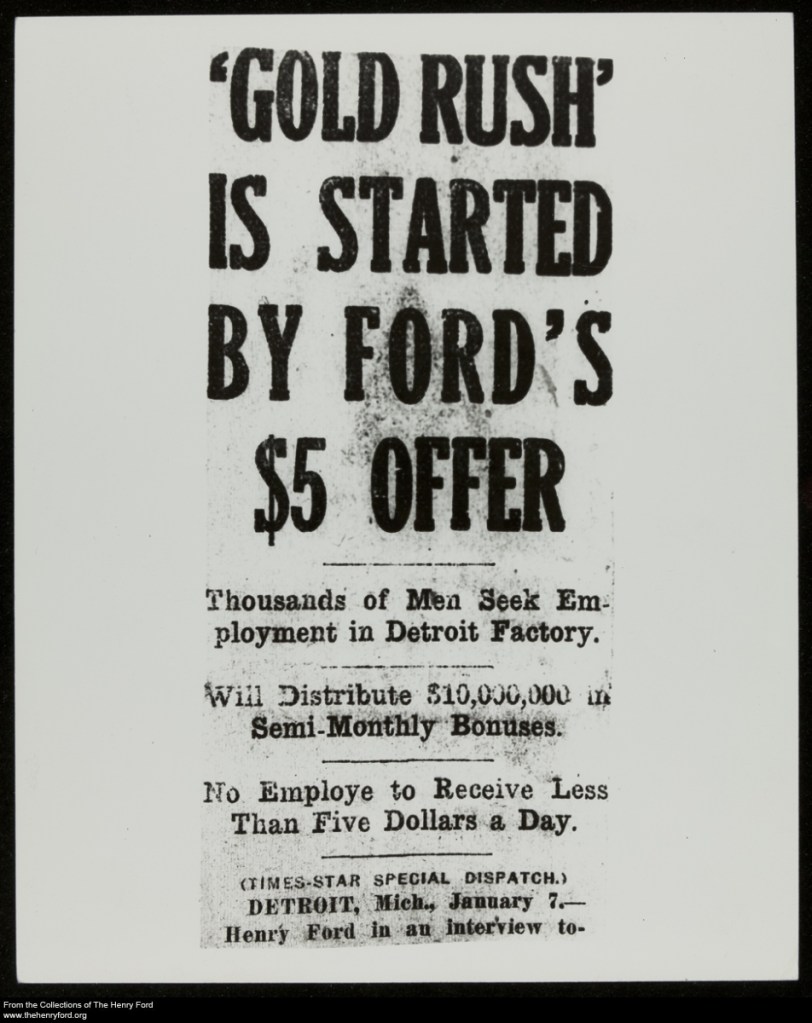
In a profit focused mentality, wages are ruthlessly lowered to the lowest tolerable point. The natural incentive for businesses is to keep wages low. However, market forces are still present to raise the minimum wage higher. Henry Ford has a famous example of doubling his workers wages to cut turnover. The factory job was monotonous and workers kept quitting. In order to prevent people from quitting, Henry Ford increased the wage. (Read More Here) Was it out of the kindness of his heart? Maybe or Maybe not. But it was good business. A spirituality of wealth seeks to highlight that treating people with dignity and respect is simply good business.
On the demand side, implementing a minimum wage would mean wages are often higher than what a business would otherwise pay. In order to maintain the same amount of profit, the easiest thing to do is to cut costs by not hiring as many people. Therefore, a natural decrease in jobs is to be expected when raising the minimum wage. The other option is to raise revenue, but for some businesses that just can’t happen. Raising revenue could come in the form of raising prices, but that could lose customers. It could come in the form of finding new customers, but low income or low population areas don’t have that liberty. The worse off would be the companies, like non-profits, whose revenue are donations or unrelated from their worker’s efforts, because all they could experience is increase costs with little to no hope of increase in revenue.
For example, a small business owner who only has a single store in a small town can’t magically increase the amount of customers that come to their store at the same time congress passes a bit of legislation. Another example, a worker who produces $x amount of revenue will continue to produce $x amount of revenue regardless of what their pay is as is the case with manufacturing industries when they have been set to their utmost efficient optimization. In addition, there are non-sales worker that are employed that have no connection to revenue such as custodial workers or back office managers.
Businesses pay their workers what they pay their workers for a reason. It is tempting to assume corporations and businesses are being greedy or stingy and are arbitrarily withholding fair wages. (some companies it may even be true.) But that is an uncharitable view of businesses. Perhaps, there are business owners that are apologetic about how much they are able to pay their staff.
I know from working for the church, there are a plethora of examples of good hard working servants that work for the Catholic Church out of a sense of mission and not a desire to be paid what they are owed. Therefore, raising the minimum wage would directly impact non-profits and low margin industries. It wouldn’t be too difficult to imagine that pushing the minimum wage to $20 an hour would break the budgets of already struggling Catholic parishes. Low margin industries such as the restaurant industry would either have to raise their prices or let their staff work less hours if not terminate some staff.
SUPPLY: Workers Wanting a Job
Let us look at the supply side now. A person must decide how much they are worth. Quite the metaphysical challenge. One of the greatest flaws of capitalism is limiting value to monetary value. If we wanted to be metaphysically accurate, then the human person is worth an infinite amount. As Psalm 8: 4-5 says, “What is mankind that you are mindful of them, human beings that you care for them? You have made them a little lower than the angels and crowned them with glory and honor.” Even more so after our Baptism and Confirmation where we become temples of the Holy Spirit and the spirit truly dwell within us. (1 Corinthian 6:19) In God’s eyes, we have an infinite value that was worth giving up His Son’s very life.
The eyes of man are much more utilitarian, unfortunately. A spirituality of wealth must resist the corrupting mindset of seeing people as tools or means to ends. Human beings are ends of themselves. The argument is that it is unacceptable to exploit workers to maximize profits. To quote my friend Chris, “the minimum wage is more like the minimal wage.” Where businesses lobby politicians to not raise the minimum wage citing valid economic concerns for their businesses. The result, however, is workers being forced to live almost in the state of abject poverty. A true minimum wage would allow for the flourishing of the human person. But is such a thing a fantasy or can it be done with Good business?
Costco and Sam’s Club are a good example about wages. The two businesses have similar business models, but Costco notoriously pays their workers better than Sam’s Club. (read more here: Read More Here) An argument could be made about different degrees of impact or customer markets, but still Costco finds a way to pay their employees well. Also, there is massive debate about whether or not increasing wages also increases productivity. I won’t go through every argument. In general, turnover goes down, which leads to experience with the company and building networks, which leads to more capable workers. Just like Henry Ford, he saved money on hiring costs by increasing retention rates which led to more productivity.
In the defense of businesses, there is a truth that after a certain point an increase of wages does not lead to an increase of productivity. That is the nature of decrease of marginal gains. The “pay me more and I’ll work more” or “I work my wage” mentality is only applicable so far. If you’re paid $7.25 an hour, then you may shirk your duties since you are not paid enough. Comically, if you’re paid $80 an hour, then you might do whatever a person asks you to do to your utmost ability. Because your quality of life would dramatically change with the increase in the amount of money. However, if you’re paid 1 million dollars a year the quality of your life wouldn’t be too different from being paid $80 an hour (166,000 a year). Therefore, there would be a natural declined in increase productivity. Not to mention at some point a human cannot be any more productive. A human can only do what is humanely possible and getting paid more would not change that.
On the supply side of the minimum wage equation, yes, humans have infinite value due to being made in the image and likeness of God. At the same time, on the demand side, a human being must be productive to a business in a way that makes the business sustainable in terms of profit. The life blood of the business relies on the productivity of its employees. So, the minimum wage can’t be infinite, but it ought not be below poverty levels either. It must be a moderate balance between these two opposing dynamic forces.
What is the worth of one hour of a human life? I don’t have the answer. It actually made me laugh during the COVID era when economists were tasked with analyzing local economies and deducing what would be a “livable wage.” The conclusion that they reached was significantly higher than the minimum wage currently in placed. Furthermore, if we allowed the minimum wage to grow with inflation, then the $7.25 we have now would be a minimum wage between $20-$25 an hour. This higher wage may indeed lead to a decrease of available jobs. But whose to say it won’t put more money in people’s pockets which would lead to more spending which would lead to more revenue which would lead to more demand for labor. Jobs will be lost, but the market would change and perhaps there might be a net positive down the road.
Regardless of your stance, it should be clear that the minimum wage as it currently is cannot afford a quality of living. Why must a person must work two hours of their life to afford a single meal at a restaurant? Even if you argue minimum wage jobs are for high schoolers or low entry level jobs, such a wage cannot sustain much of anything. Do not be surprised if the same people that say, “kids don’t work like they used to” are the same people that say, “we should not raise the minimum wage.”
Perhaps, kids don’t work like they used to because it is not worth the effort. One of the biggest motivator for a high schooler to get a job is to raise enough money for their own car. Simple math, in order to pay for a $5000 car you would need to work 690 hours or 86 eight hour days or 17 business weeks of summer vacations. That is assuming you get to keep every penny of the minimum wage which doesn’t happen due to income tax. If a gallon of gasoline costs $30, then you would need to work 4-5 hours just to afford gas. After doing the math, isn’t the more economically sound choice to figure out how to live without a car? Otherwise, your whole high school experience is slaved away doing a job that is treated both by the buyer and seller as low value.
Psalm 90:10 reminds us that we have about 70-80 years to live on average. 80 years * 365 days * 24 hours = 700, 800 hours. One hour of our life may not seem like much, but we won’t ever get it back. If employers are grateful for their workers and value the dignity intrinsic to all human beings, then it shouldn’t be too much to ask to pay enough to ensure a certain minimum quality of life. Maybe not the most luxurious life, but a life that has limited financial insecurity within reason.
I do not have the intelligence nor the audacity to say what the minimum wage should be. It is beyond my paygrade to come up with such a number. Especially, if the number is destined to change every several years. I’ll just say that the number is too low as is and the market shows us that.
The market itself is indicating that the minimum wage is too low. The starting salaries of traditionally minimum wage jobs are rising. In my area, I often see $12/hr or even $15/hr for fast food positions. The minimum wage isn’t serving as a price floor, lately. Businesses are realizing that if they want quality labor that won’t leave after a few months, then they will need to pay people more than the $7.25. The businesses that do pay $7.25 AND are concerned about going out of business if the minimum wage is raised may have an ethical problem. Because if it is really true that their business cannot survive without lower than dignified wages, then there is a flaw in their business model. Those businesses must improve or admit that they require people to live in poverty to turn a profit.
God willing, people are able to find dignified work that can sustain their family. I mean that for both workers and business owners.

 The Average Catholic: More Articles Here!
Leave a comment