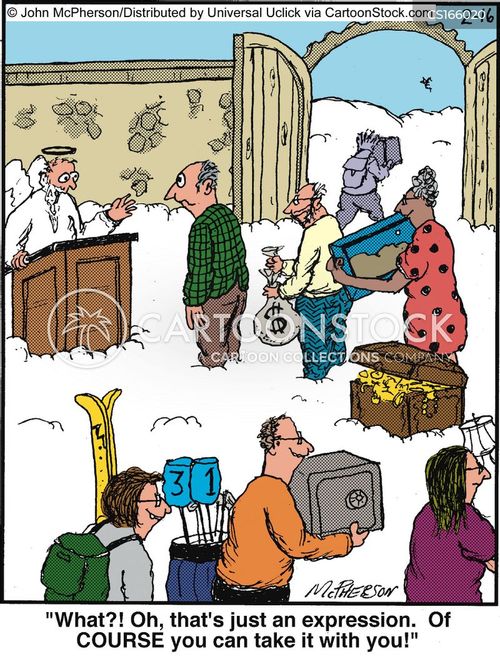
What is the economically efficient way to hold on to wealth? This is not a moral “got you” about right and wrong. It is an honest question of how much money should we have when we die? Prudential judgement is the correct answer. There shouldn’t be a hard and steadfast rule. If we, Average Catholics, value going to heaven, and if money in our bank account doesn’t help us to heaven, then how much money should be in our bank account when we die?
Warren Buffett has been in the news about his $6 billion dollar donation to charity. I have the highest praise for Warren Buffett. I believe he offers sounds advice and represents a principled capitalism that is rare. The 94 year old billionaire is ranked as 7th richest person and has begun discussing how his wealth will be distributed. You can read more about the donation with the link below.
The amount of billionaires living in the world is unprecedented. Never before has such wealth existed and never before has such wealth been held by individuals that were not leaders of governments. As the billionaires grow older, the question becomes what will happen to their money after they pass away. Whatever the answer is it must humbly be applied to our own situations. We can’t expect to profess moral standings about billionaires and not apply it to ourselves.
Do you get bonus points in heaven for having a large bank account? I’m sure you already know the answer but let’s look at some bible quotes.
- Be not afraid when a man becomes rich, when the glory of his house increases. For when he dies he will carry nothing away; his glory will not go down after him. For though, while he lives, he counts himself blessed— and though you get praise when you do well for yourself— his soul will go to the generation of his fathers, who will never again see light. Man in his pomp yet without understanding is like the beasts that perish. – Psalm 49:16-20
- And I will say to my soul, “Soul, you have ample goods laid up for many years; relax, eat, drink, be merry.”’ But God said to him, ‘Fool! This night your soul is required of you, and the things you have prepared, whose will they be?’ So is the one who lays up treasure for himself and is not rich toward God.” – Luke 12:19-21
- “One who is faithful in a very little is also faithful in much, and one who is dishonest in a very little is also dishonest in much. If then you have not been faithful in the unrighteous wealth, who will entrust to you the true riches? And if you have not been faithful in that which is another’s, who will give you that which is your own? No servant can serve two masters, for either he will hate the one and love the other, or he will be devoted to the one and despise the other. You cannot serve God and money.” – Luke 16:10-13
- The poor man died and was carried by the angels to Abraham’s side. The rich man also died and was buried, and in Hades, being in torment, he lifted up his eyes and saw Abraham far off and Lazarus at his side. And he called out, ‘Father Abraham, have mercy on me, and send Lazarus to dip the end of his finger in water and cool my tongue, for I am in anguish in this flame.’ But Abraham said, ‘Child, remember that you in your lifetime received your good things, and Lazarus in like manner bad things; but now he is comforted here, and you are in anguish. – Luke 16:22-25
- Then Jesus told his disciples, “If anyone would come after me, let him deny himself and take up his cross and follow me. For whoever would save his life will lose it, but whoever loses his life for my sake will find it. For what will it profit a man if he gains the whole world and forfeits his soul? Or what shall a man give in return for his soul? For the Son of Man is going to come with his angels in the glory of his Father, and then he will repay each person according to what he has done. – Matthew 16:24-28
- He also who had received the one talent came forward, saying, ‘Master, I knew you to be a hard man, reaping where you did not sow, and gathering where you scattered no seed, so I was afraid, and I went and hid your talent in the ground. Here, you have what is yours.’ But his master answered him, ‘You wicked and slothful servant! You knew that I reap where I have not sown and gather where I scattered no seed? Then you ought to have invested my money with the bankers, and at my coming I should have received what was my own with interest. – Matthew 25:24-27
The message “You can’t take it with you” is a biblical reminder that our wealth does not benefit us in the next life. Possessing a large amount of money is truly an achievement. Such large sums are not acquired by accident. A person needs to have smarts, discipline, focus, and conviction. There are a bountiful amount of virtues that are required in order to enter the upper echelon of wealth. Kudos are deserved to those who earned them. The Average Catholic is probably not a billionaire and is probably lucky to be considered middle class. We too need virtues in order to have financial stability on this side of heaven. However, when we get to heaven we shall be judged for how much love we showed to God and neighbor.
Do we get bonus points for having a big bank account? No. In fact, we might be judged all the more harshly by the lack of use of our funds while living. Capitalism is set up in such a way that those who become rich is because they offer goods and services that is a benefit to the population at large. In an ideal world, wealth is a sign for how much good has been done by the wealthy’s choice of industry.
In one sense, it truly is an admirable achievement to die with a fortune to your name. In all sincerity, there is praise worthiness of being able to amass an inheritance worth passing on. In biblical times, wealthy individuals were seen as favored by God. Job, Abraham, Isaac, Jacob, David, and Solomon all amassed wealth as a sign of God’s favor to them. Even the disciples were shocked when Jesus told them, “It is easier for a camel to go through the eye of a needle than for a rich person to enter the kingdom of God.” (Mark 10:25)
In another sense, our life does not end at death; it only changes. To borrow from the paschal wager, we must factor into the value of our material possessions with regards to our spiritual souls. How much money should be in our bank account? If we look at it from purely an economic perspective and if we allow for the existence of eternal life at death, then having money in our bank account is no benefit to us on our death bed. In fact, it would be more beneficial to give away the money similar to a steward who is networking for his next employment opportunity in the form of bribes to competing firms. (Luke 16:8-9) A large amount of money in our bank account at our death should be a fear inducing experience for those who fear God.

Similar to the chains of Jacob Marley in the Christmas Carol. A large bank account, which was previously a sign a virtue, suddenly becomes a condemnation of what little was done with our financial assets at our death bed. Jesus tells us, “It is more blessed to give than to receive.” (Acts 20:35). The perspective we must sear into our hearts is that material possessions are a GIFT. Yes, hard work and dedication by our own efforts brought about a fortune. Yet, everything we have have been given to us. If we claim anything for ourselves it is because we originally started with what the Lord gave us. A large bank account could thus be seen as keeping a gift that was meant to be given away. Let Matthew 25 be in the front of our minds as we plan our estates.
“Then he will say to those on his left, ‘Depart from me, you cursed, into the eternal fire prepared for the devil and his angels. For I was hungry and you gave me no food, I was thirsty and you gave me no drink, I was a stranger and you did not welcome me, naked and you did not clothe me, sick and in prison and you did not visit me.’ Then they also will answer, saying, ‘Lord, when did we see you hungry or thirsty or a stranger or naked or sick or in prison, and did not minister to you?’ Then he will answer them, saying, ‘Truly, I say to you, as you did not do it to one of the least of these, you did not do it to me.’ And these will go away into eternal punishment, but the righteous into eternal life.” – Matthew 25:41-46
I invite you Average Catholics to reimagine estate planning. Imagine if we forfeit all of our wealth to the next generation before we died. We spend the last decades of our life living off of the generosity of the next generation. Scary? Don’t have anyone to trust to take care of you? Fearful of unexpected events during your retirement? Honestly think about why we wait until death to pass on our inheritances. Why do we avoid conversations about death until death is at our door?
Remember, the famous prayer of Job, “And he said, “Naked I came from my mother’s womb, and naked shall I return. The Lord gave, and the Lord has taken away; blessed be the name of the Lord.” (Job 1:21) What would it take to be on our death bed with $0. Of course, if we are poor already, then that’s just the reality that we live in. But if we have wealth, then how much trust and faith will we need to have to give away our fortune while we are still alive? We may not be billionaires, but is it much different to have thousands of dollars in the bank at the time of our death?
A spirituality of wealth requires us to think about how to use our money with intention. That includes our plans on how to distribute it after we pass away. For some reason, this is a private matter that is rarely discussed as a family. I don’t have the words to express it. But it seems unchristian to have estate planning be a surprise to the family. Mind, Body, Soul, and wallet all must be directed towards the love of God and neighbor. Tomorrow is not promised to us. Don’t let fear stop us from being the Catholics that God is calling us to be.
 The Average Catholic: More Articles Here!
Leave a comment