
The life blood of capitalism is to make a profit. The familiar equation of revenue minus cost equals profit is burned into every entrepreneur. How can we minimize costs and maximize revenue? Profit is the driving force between most if not all capitalistic activity. The big question is how much money can we make off of this good and/or service. Our ability to produce profit makes us more valuable in a capitalistic society. We see profit as a return in investment, but what would happen if we see profit as gratitude for what we are providing?
There have been some terrible and sinful things done to maximize profits. It would be a simple matter to look up abuses in the past that could justify eliminating capitalism entirely. However, the foundation of Capitalism is mutually beneficial exchange of goods/services/money. Making profit shouldn’t be about “how can we trick someone into spending more money.” Profit should be more about gratitude for the value provided by the goods or services.
There is a Demetri Martin joke that visualizes this perfectly. The joke starts by observing people say, “thanks a million.” But they do not say any number besides a million. It’s weird to say, “thanks 257.” What you did wasn’t worth a million. You know what? Thanks 256 for questioning me. You want to keep going? We’re heading for thank zero which means no thanks.
If a seller offers a product that a buyer does not want, then they will say, “No thank you.” (Assuming that the costumer is polite.) The customer did not have enough gratitude to what the seller was offering. However, if you offer a great product for cheaply, then the buyer will excitedly buy it. “That’s a deal!” We have all experienced the pleasure of getting a good deal. Our gratitude is evident at someone supplying something that we demand at such a low cost.
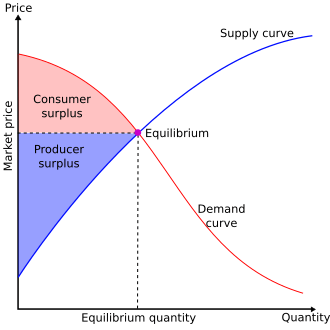
We pull up a simple supply and demand graph. We see that if a product is sold at too high of a price, then the consumer will not buy it. We also see that if a seller has the price too low, then it is not worth selling by the seller. The equilibrium point is both the seller and the buyer are aligned as to how many items to purchase and at what cost. This is the most efficient outcome with no waste or unfilled demand. At the equilibrium point, everyone has their desires fulfilled!
To the RIGHT of the equilibrium point, We see how the supplier would desire to sell more at the higher price, but there is not enough demand from the consumers to purchase it at the same price. Some people would buy the product at the higher price, but not everyone one. The ones who don’t has their desire unfilled due to refusing to buy.
To the LEFT of the equilibrium point, we are in a zone where both the consumer and the buyer experience a surplus. The consumer is demanding more product at the low price. While, the seller could have made more sales, but ran out of product. This too leaves buyers with their desires unfilled. The supplier then has to deal with a surplus of product or services that only a few desire.
For me, it is important to see products in capitalisms as solutions to problems that people have. The old adage, “people don’t buy drills, they buy holes” says it all. A person is looking to drill a hole. A drill is able to drill a hole therefore there is a desire to acquire a drill. There is a demand in the economy because the buyer has a problem that is solved by a product. The seller then sells the solution to the problem. The buyer then pays the cost of the product and then some for profit towards the seller. I want to see that profit as gratitude.
A profitable company becomes a catalyst of gratitude in a capitalistic society.
Let us use cookies as an example. We have the option of baking our own cookies. Or we have the option for buying the cookies at the store. Let us say that the cookies at the store costs $5. Let us also say that the cost for making our own cookies with supplies and our time is $10. The store can then sell the cookies between $5 to $10 which is below the cost of baking our own cookies, but higher than the cost of the store’s investment. The profit the store experiences is then our gratitude to having quality cookies for cheaper than would cost us to make ourselves. If the buyer were to be charged more than $10 then there would be no gratitude and they could easily say, “I’ll just bake the cookies myself.”
How would going to the store change our behavior knowing profit is a sign of gratitude? Hopefully, we will choose products that we truly are grateful for for existing. We see our favorite soft drink and think, “Yes! Make more of these please.” We see our least favorite soft drink and think, “Gross! They need to stop making this.”
Every purchase that we make is a vote saying that this product is mutually beneficial. If you don’t support a company for moral reasons, then why are you buying their products? Also, if you want the company to stay in business, then buy their products! If you enjoy museums and theaters, then buy tickets to shows or convince your friends to go. If you want more small businesses, then be sure to shop at small businesses. Let your gratitude motivate your economic activity.
I know some companies make profit due to abusive practices. There are also companies that take advantage of people’s weakness and insecurity. That is bad capitalism. The transactions ought to be mutually beneficial. The buyer must have the know how to get a good deal and the seller must have the integrity to offer a product that is truly beneficial to society.
God willing, when we see companies post their profits, then we also see the value they provide to society. Thank you to all of the corporations and businesses out there. Thank you for the goods and services that are provided in abundance. Thank you for trusting that the buyer’s dollar can sustain your existence. Thank you for the fun of festivals and entertainments. Thank you for delivering my food. Thank you for my education. Thank you for my health. Thank you for my utilities. Thank you for running an ice cream stand. A profitable company becomes a catalyst of gratitude in a capitalistic society. Thanks for your business!
 The Average Catholic: More Articles Here!
Leave a comment